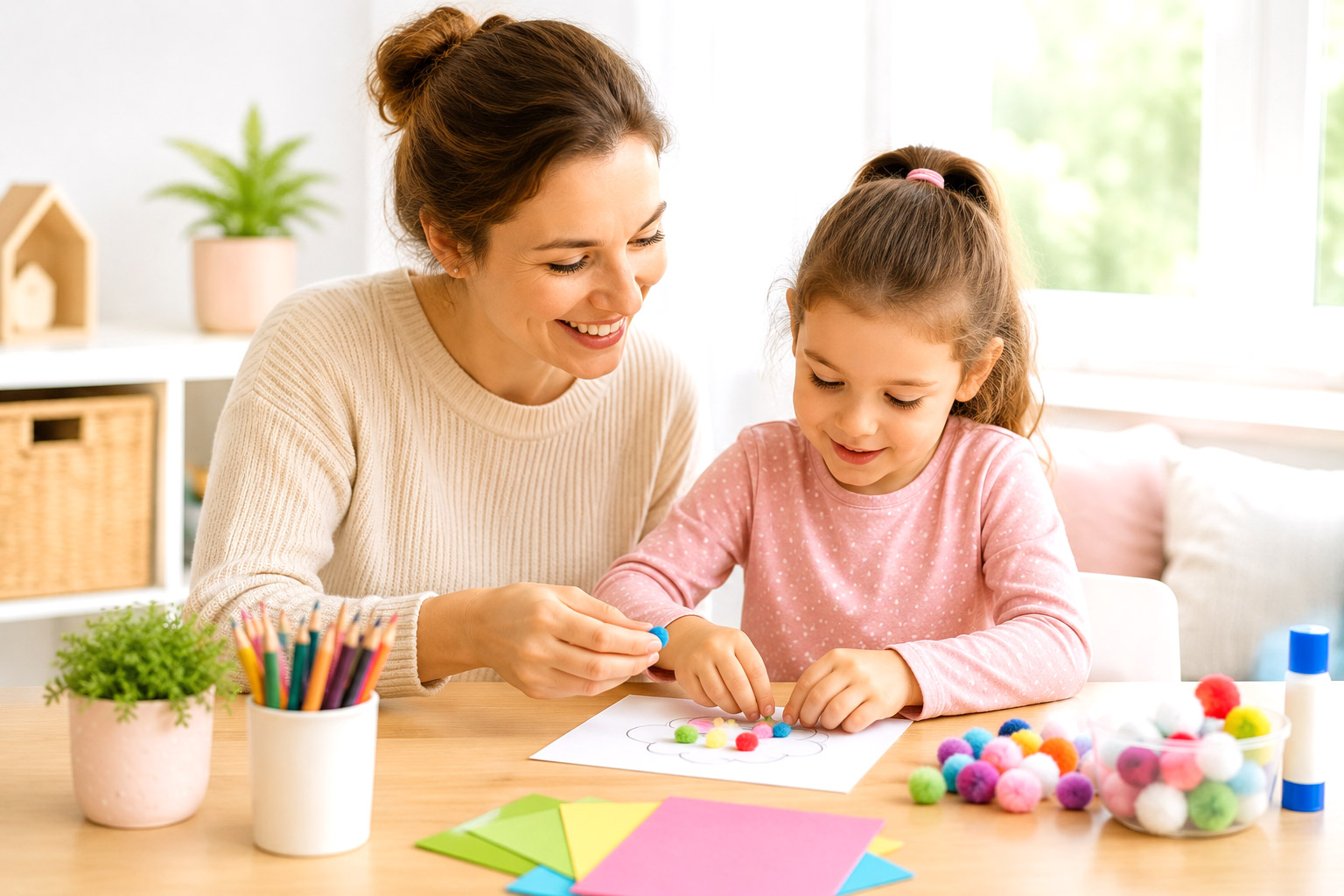
Many parents want to support their child before they start school. However, learning and practicing do not have to feel like formal lessons. With suitable kindergarten activities at home, children can develop important skills naturally through play—without pressure and without spending hours on worksheets.
Children in kindergarten learn best through movement, exploration, experimentation, and repetition. This is why short, playful activities are often far more effective than rigid learning programs.
In this article:
- Why Kindergarten Activities at Home Are Helpful
- Which Skills Can Be Developed?
- 10 Easy Kindergarten Activities at Home
- Integrating Learning into Everyday Life
- What Parents Should Avoid
- Conclusion
Why Kindergarten Activities at Home Are Helpful
Children learn every day—naturally and automatically. Additional activities at home can help strengthen important foundations for school in a playful way.
These activities especially support:
- fine motor skills
- concentration
- language development
- logical thinking
- creativity
- independence
The most important thing is that children enjoy the activities and do not feel constant pressure to perform.
Which Skills Can Be Developed?
During the kindergarten years, children develop in many different areas at the same time. This is why offering varied activities is especially beneficial.
Typical developmental areas include:
- language and vocabulary
- fine motor skills
- visual perception
- number understanding
- concentration
- social skills
Even just a few minutes of daily activities can have a significant long-term impact.
10 Easy Kindergarten Activities at Home
Many of the best activities require very little material and can be started immediately.
1. Sorting Objects
Sort buttons, building blocks, or toys by color, size, or shape.
2. Finding Pictures
Look for specific objects in picture books together.
3. Playing Memory Games
Memory games strengthen concentration and memory skills.
4. Playing with Modeling Clay
Kneading and shaping clay develops fine motor skills and hand strength.
5. Discovering Letters
Search for first letters on signs, packaging, or labels.
6. Finding Rhymes
Rhyming games encourage language development in everyday situations.
7. Creating Patterns
Use stones, buttons, or building blocks to create simple sequences and patterns.
8. Cutting Activities
Cutting exercises strengthen scissor skills and finger coordination.
9. Reading Together
Reading aloud supports language development and concentration.
10. Obstacle Courses
Small indoor or outdoor obstacle courses improve motor skills and body awareness.
Integrating Learning into Everyday Life
The best learning opportunities often happen naturally during everyday routines.
Typical everyday learning situations include:
- counting while shopping
- naming colors
- discovering traffic signs
- cooking together
- comparing objects
- finding rhyming words
This helps children experience learning as a natural part of everyday life.
What Parents Should Avoid
Even well-intentioned support can lead to frustration if children feel overwhelmed.
Parents should avoid these common mistakes:
- activities that last too long
- constant corrections
- comparing children with others
- creating pressure to perform
- doing too many activities in a row
Short sessions of about five to fifteen minutes are usually completely sufficient.
Conclusion
Kindergarten activities at home do not need to be complicated or time-consuming. Children learn best through play, exploration, and their own experiences.
Simple everyday activities can naturally strengthen concentration, fine motor skills, language, and creativity—without pressure.
Frequently Asked Questions About Kindergarten Activities at Home
How long should children practice each day?
Usually, five to fifteen minutes are completely sufficient.
Do children need special worksheets?
No. Many important skills can be developed naturally through everyday play and experiences.
Which activities improve concentration?
Memory games, puzzles, search games, and reading aloud are especially helpful.
Are digital learning games useful?
They can be helpful as a supplement, but real-life experiences should remain the priority.
What is the most important rule?
Children should enjoy learning and never feel pressured.
ABC with Yeti is a lovingly designed learning app for preschool and elementary school children.
Children learn playfully:
- letters
- handwriting
- first words
The app offers:
- 8+ learning activities
- 80 unlockable animals
- 9 different handwriting fonts
- Suitable for kindergarten, preschool, and elementary school
Discover More Preschool Tips
From fine motor development and concentration activities to letter learning and school readiness, you’ll find many practical ideas for preschool children.
Explore all Parent Tips →