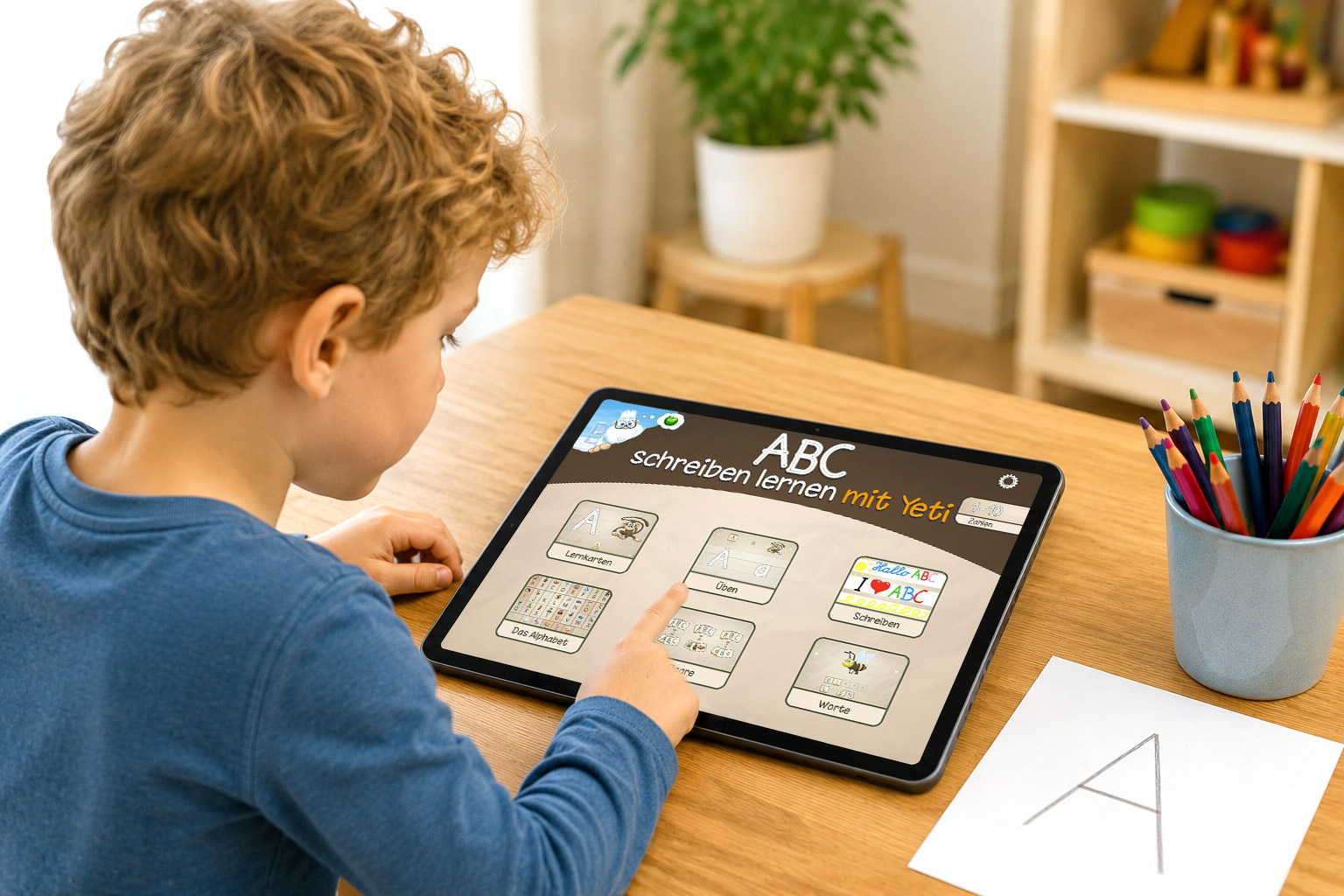
Tablets have become a normal part of everyday family life. Many preschool children come into contact with digital devices early on and are often interested in apps, games, and educational programs.
Digital media can support children’s learning, but they cannot replace real-life experiences, physical activity, or shared activities. What matters most is how tablets are used.
When used appropriately, educational apps can support letter learning, language development, and first writing attempts. At the same time, parents should aim for a healthy balance between digital and hands-on experiences.
In this article:
- What Are the Benefits of Tablets?
- What Are the Risks?
- How to Recognize Good Educational Apps
- How Much Screen Time Is Appropriate?
- Tips for Everyday Family Life
- Conclusion
What Are the Benefits of Tablets?
Well-designed educational apps can motivate children and support learning.
Preschoolers especially benefit from interactive activities that allow them to listen, watch, and actively participate.
Possible benefits include:
- playful introduction to letters
- support for language development
- early writing practice
- individual learning pace
- high motivation through immediate feedback
Digital learning tools can therefore be a valuable addition to everyday life.
What Are the Risks?
Tablets should never replace other important experiences.
Children learn especially through movement, conversations, arts and crafts, play, and direct interaction with other people.
Potential risks mainly arise from:
- excessive screen time
- inappropriate content
- lack of adult guidance
- too little physical activity
- overuse of digital media
That is why it is important to use tablets consciously and in an age-appropriate way.
How to Recognize Good Educational Apps
Not every colorful app provides real educational value.
Good educational apps usually have the following characteristics:
- age-appropriate content
- simple and intuitive navigation
- minimal distractions
- no advertising
- positive encouragement instead of pressure
- active participation by children
Apps that encourage children to think, speak, write, or experiment are particularly valuable.
How Much Screen Time Is Appropriate?
A fixed number of minutes is often less important than the quality of the content.
Many experts recommend short sessions with regular breaks for preschool children.
Helpful strategies include:
- using tablets together with parents
- establishing clear rules
- taking regular breaks
- ensuring plenty of physical activity
- offering varied leisure activities
Tablets should always make up only a small part of the day.
Tips for Everyday Family Life
Digital media work best as a complement to real-world experiences.
Parents can accompany their child, answer questions, and explore content together.
Helpful approaches include:
- trying educational apps together
- talking afterwards about the content
- practicing letters or words offline as well
- combining digital and hands-on activities
Conclusion
Tablets are neither inherently good nor bad.
What matters most is which content children use and how adults support and guide them.
Carefully selected educational apps can meaningfully support preschoolers. However, movement, play, reading together, and shared real-life experiences remain the most important foundations for healthy development.
Frequently Asked Questions About Tablets for Preschoolers
Are tablets suitable for preschool children?
Yes, if age-appropriate content is used and parents actively accompany and guide their child.
What educational apps are recommended?
Apps with clear learning goals, simple navigation, and no advertising are usually the best choice.
How long should preschoolers use a tablet?
Short sessions with regular breaks are generally more beneficial than long periods of screen time.
Can tablets support learning to write?
Yes, as a supplement to practical experiences and real handwriting activities.
Should tablets replace traditional learning activities?
No. Digital learning should complement, not replace, movement, play, reading, and real-world experiences.
ABC with Yeti is a lovingly designed learning app for preschool and elementary school children.
Children learn playfully:
- letters
- handwriting
- first words
The app offers:
- 8+ learning activities
- 80 unlockable animals
- 9 different handwriting fonts
- Suitable for kindergarten, preschool, and elementary school
Discover More Parent Tips
From first letters and fine motor skills to pencil grip and school readiness: explore many more practical activities and ideas for preschoolers and elementary school children.
Explore all Parent Tips →