
Many children become interested in letters during the preschool years and want to make their first attempts at writing. Before children can write letters independently, tracing activities help them learn the shapes of individual letters and practice important movement patterns.
By tracing letters, children playfully strengthen their fine motor skills, hand-eye coordination, and pencil control. At the same time, they develop a better understanding of the shape and structure of letters.
In this article:
- Why Is Tracing Letters Helpful?
- When Can Children Start Tracing Letters?
- The Best Letter Tracing Activities
- Tracing Letters in Everyday Life
- Common Mistakes to Avoid
- Using Digital Support Wisely
- Conclusion
Why Is Tracing Letters Helpful?
Tracing letters is one of the most important preparation activities for later handwriting. Children learn how individual letters are constructed and which movements are necessary for writing.
At the same time, several important skills are strengthened:
- fine motor skills
- hand-eye coordination
- pencil control
- concentration
- letter awareness
Regular tracing helps children gain confidence and self-assurance when using pencils and paper.
When Can Children Start Tracing Letters?
Many children begin showing interest in letters between the ages of four and six. As soon as a child enjoys drawing, tracing lines, or creating simple shapes, first tracing activities can be introduced.
The letters in a child’s own name are often especially motivating because they have personal meaning.
The Best Letter Tracing Activities
Children learn particularly well when different materials are used.
- trace large letters on worksheets
- trace letters with sidewalk chalk outdoors
- draw letters in sand with a finger
- form letters from modeling clay and trace them afterwards
- paint letters using finger paints
- trace large letters on paper
It is important to use sufficiently large letters. Large movements are much easier for preschoolers than small, precise lines.
Tracing Letters in Everyday Life
Tracing activities do not always need to take place at a desk.
Many opportunities naturally arise during everyday life:
- discovering letters on street signs
- tracing letters on packaging
- drawing letters with a finger on foggy windows
- drawing letters in sand or soil
- creating letters from natural materials
The more varied the activities, the higher children’s motivation will remain.
Common Mistakes to Avoid
Many parents want to see rapid progress. However, this often creates unnecessary pressure.
Common mistakes include:
- using letters that are too small
- sessions that are too long
- constant corrections
- expecting perfection
- not allowing enough breaks
Short, playful sessions of five to ten minutes are usually completely sufficient.
Using Digital Support Wisely
Digital learning tools can be a useful addition to letter tracing activities.
Apps that demonstrate the correct stroke order and provide immediate feedback can be especially helpful.
However, digital exercises should complement rather than replace practical experiences with pencils, paper, sand, or modeling clay.
Conclusion
Tracing letters is an ideal preparation for later handwriting.
Children become familiar with letter shapes, strengthen important motor skills, and gain confidence when using pencils and paper.
Through varied activities and plenty of fun, children build an important foundation for successful learning at school.
Frequently Asked Questions About Tracing Letters
At what age can children start tracing letters?
Many children begin their first tracing activities between the ages of four and six.
How long should children practice?
Five to ten minutes per day are usually sufficient.
Which letters are best to start with?
The letters in a child’s own name are often especially motivating.
Does tracing help children learn to write?
Yes. Children practice important movement patterns and develop a better understanding of letter shapes.
Should children only trace on worksheets?
No. Children also benefit from tracing letters in sand, with chalk, or using creative materials.
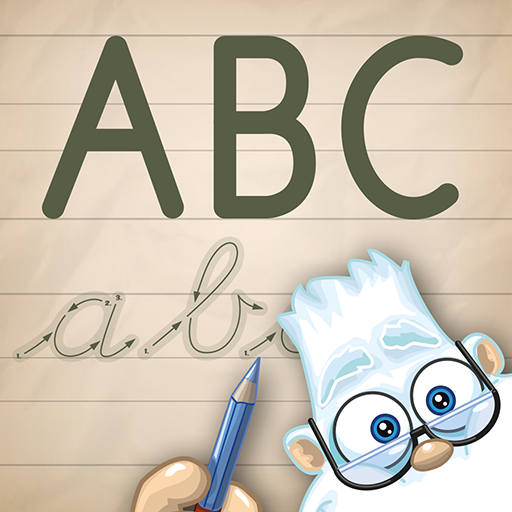
ABC with Yeti is a lovingly designed learning app for preschool and elementary school children.
Children learn playfully:
- letters
- handwriting
- first words
The app offers:
- 8+ learning activities
- 80 unlockable animals
- 9 different handwriting fonts
- Suitable for kindergarten, preschool, and elementary school
Discover More Parent Tips
From first letters and fine motor skills to pencil grip and school readiness: explore many more practical activities and ideas for preschoolers and elementary school children.
Explore all Parent Tips →