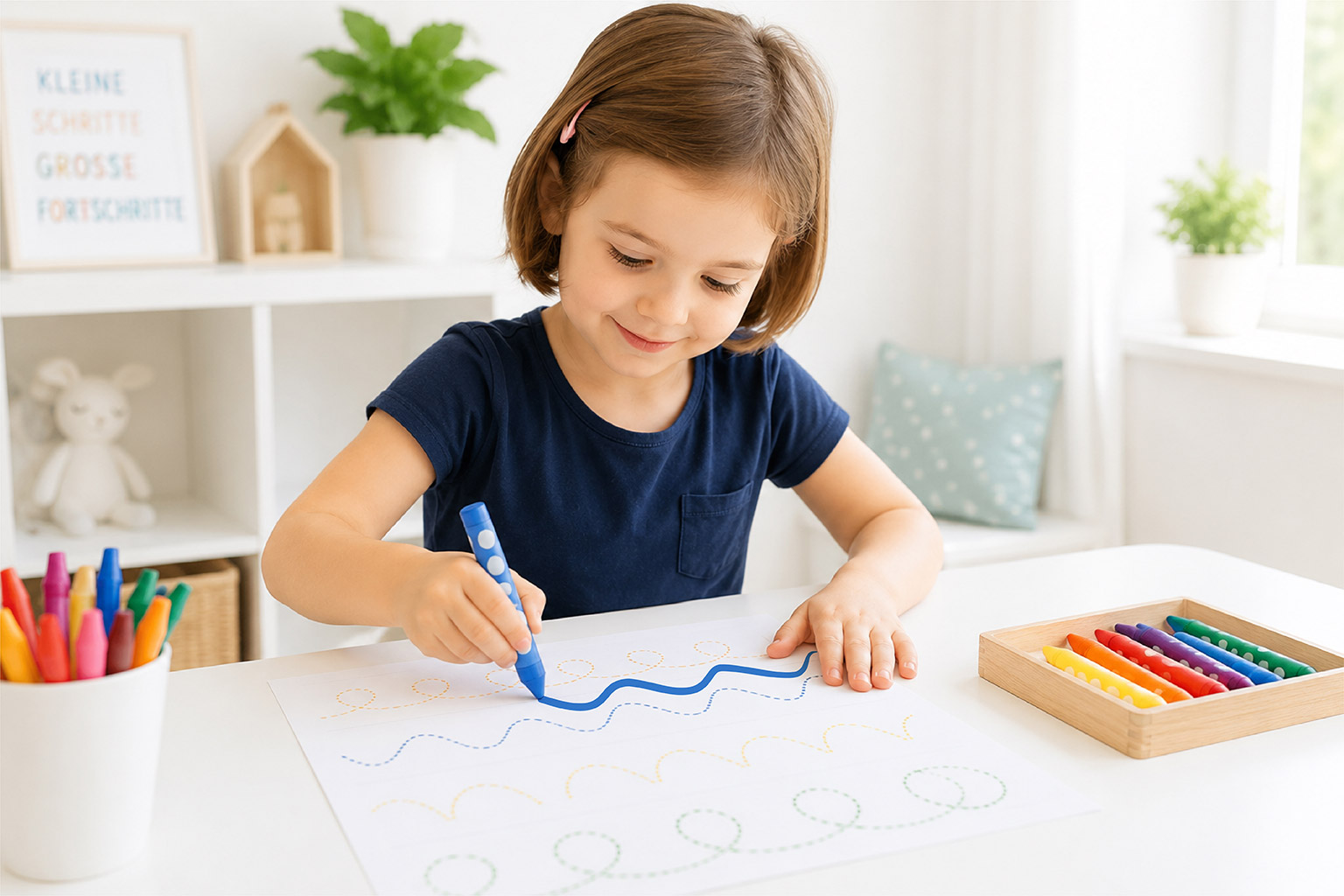
Pre-Writing Tracing Activities for Preschoolers are among the most important early exercises for learning to write. Before children can write letters and words, they first need to learn how to confidently draw lines, curves, loops, and simple shapes.
The good news is that pre-writing activities are fun for many children and can easily be integrated into everyday life through playful experiences. At the same time, they strengthen fine motor skills, concentration, and pencil control.
In this article, you’ll learn why tracing activities are important, which skills they support, and which exercises work especially well at home.
In this article:
- Why Are Pre-Writing Activities Important?
- Which Skills Do They Develop?
- The Best Pre-Writing Activities at Home
- Common Mistakes to Avoid
- Preparing for Learning to Write
- Conclusion
Why Are Pre-Writing Activities Important?
When parents think about learning to write, they often focus on letters first. In reality, the foundations are developed much earlier.
Children first need to learn how to control movements with a pencil. This is exactly where pre-writing activities help.
Lines, circles, waves, and loops train movement patterns that children later need when writing letters.
Which Skills Do Pre-Writing Activities Develop?
Pre-writing activities train much more than simple hand movements.
They help strengthen:
- fine motor skills
- hand-eye coordination
- concentration
- pencil control
- movement planning
- finger strength
These abilities later form the foundation for fluent and relaxed handwriting.
The Best Pre-Writing Activities at Home
Children learn best through varied and playful activities.
Popular pre-writing activities include:
1. Trace Straight Lines
Practice following simple horizontal, vertical, and diagonal lines.
2. Draw Wavy Lines
Waves help children practice smooth, flowing movements.
3. Create Zigzag Lines
Zigzags improve direction changes and movement control.
4. Draw Circles and Spirals
Circular movements prepare children for many letter shapes.
5. Connect Dots
Joining dots improves visual tracking and coordination.
6. Solve Simple Mazes
Mazes strengthen concentration and pencil control.
7. Draw Rainbows
Large arching movements support shoulder and arm control.
8. Practice Large Loops
Loop movements prepare children for cursive writing patterns later on.
At first, movements should be large and relaxed. Over time, activities can gradually become smaller and more precise.
Common Mistakes to Avoid
Many children lose interest in tracing activities when they are corrected too often.
Try to avoid:
- activities that are too difficult
- long practice sessions
- constant corrections
- time pressure
- comparing children with others
Enjoying the process is far more important than drawing perfect lines.
Preparing for Learning to Write
Children who regularly practice pre-writing activities often feel more confident when they begin writing letters.
These exercises teach children how to control movements and guide a pencil intentionally, making the transition to handwriting easier.
Conclusion
Pre-Writing Tracing Activities for Preschoolers are an ideal preparation for learning to write.
They strengthen fine motor skills, concentration, and pencil control and can easily be integrated into everyday life.
Through regular playful practice, children develop important foundations for a successful start at school.
Frequently Asked Questions About Pre-Writing Activities
At what age should children start pre-writing activities?
Many children begin their first tracing activities between the ages of four and six.
How long should children practice?
Five to ten minutes a day is usually enough.
Are worksheets necessary?
No. Many activities can also be done freely on paper, in sand, or with finger paints.
Why do pre-writing activities help with learning to write?
They train movement patterns that children later need for writing letters.
Should children already know letters before doing tracing activities?
No. Pre-writing activities are designed to build the foundational skills children need before formal handwriting begins.
ABC with Yeti supports children in learning to write through playful exercises, letter practice, and multiple handwriting fonts.
Children learn playfully:
- writing letters
- practicing handwriting
- building first words
The app offers:
- 8+ learning activities
- 80 unlockable animals
- 9 handwriting fonts
- Suitable for preschool, kindergarten and elementary school
Discover More Parent Tips
From letters and fine motor skills to pre-writing activities and school readiness: explore many more practical tips and exercises for preschoolers and elementary school children.
Explore all Parent Tips →