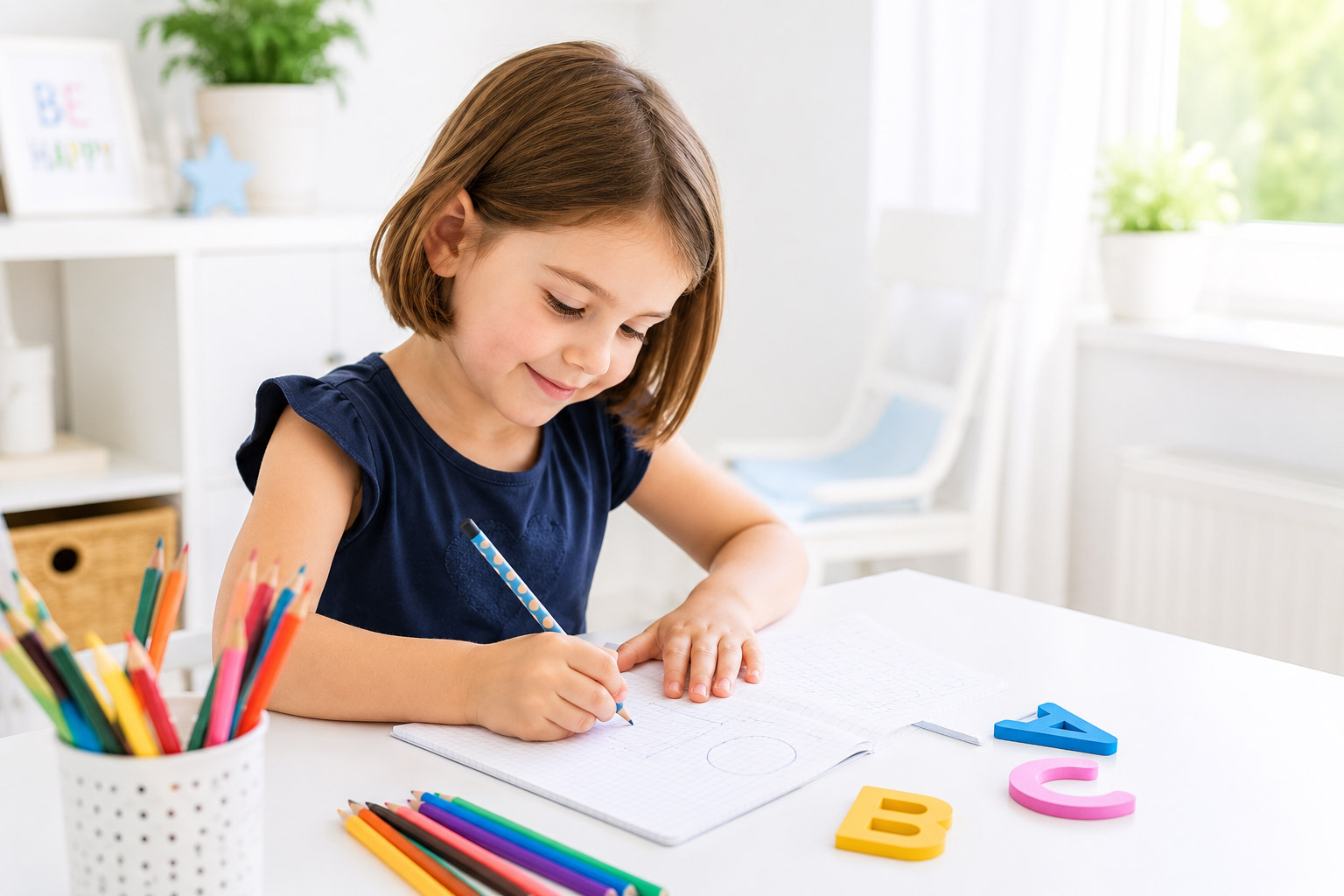
Improving Pencil Grip in preschool works best through play. Many children do not naturally develop an efficient pencil grip on their own and benefit from a variety of activities that strengthen fine motor skills, finger strength, and coordination.
The good news is that children do not need to spend hours practicing writing. Simple everyday activities can help build the foundations for a relaxed and comfortable pencil grip.
In this article, you’ll learn why pencil grip matters, how it develops, and which activities can support your child at home.
In this article:
- Why Is Pencil Grip Important?
- How Does Pencil Grip Develop?
- The Best Activities to Try at Home
- Common Mistakes Parents Should Avoid
- Preparing for School
- Conclusion
Why Is Pencil Grip Important?
A good pencil grip makes learning to write much easier for children. It helps prevent hand fatigue and allows children to make more precise movements while drawing and writing.
Children who hold a pencil comfortably and without excessive tension often write more fluently and develop legible handwriting more easily.
It is important to remember that not every child develops the ideal pencil grip at exactly the same age. Small differences are completely normal.
How Does Pencil Grip Develop?
Before children can confidently hold and control a pencil, many fine motor skills first need to develop.
Important foundational skills include:
- finger strength
- hand-eye coordination
- finger mobility
- using both hands together effectively
- control of small movements
These abilities typically develop through everyday play, arts and crafts, and hands-on experiences.
The Best Activities to Try at Home
Many playful activities naturally support the development of a comfortable pencil grip.
Especially effective activities include:
1. Roll and Shape Play Dough
Rolling, squeezing, and shaping dough strengthens hand and finger muscles.
2. Thread Beads
Stringing beads improves finger coordination and precision.
3. Sort Pom-Poms with Tweezers
Picking up small objects with tweezers strengthens the pincer grasp needed for writing.
4. Attach Clothespins
Opening and closing clothespins builds finger strength.
5. Practice Cutting with Child-Safe Scissors
Cutting activities improve hand control and coordination.
6. Color Mandalas and Pictures
Coloring helps children practice controlled hand movements.
7. Trace Letters
Tracing large letters encourages correct movement patterns.
8. Practice Pre-Writing Strokes
Simple lines, loops, and curves prepare children for later handwriting.
Just a few minutes of practice each day can make a significant difference.
Common Mistakes Parents Should Avoid
Many parents try to constantly correct their child’s finger position. However, this often leads to frustration rather than progress.
Try to avoid:
- constant correction
- putting children under pressure for long periods
- comparing children with others
- using pencils that are too thick or unsuitable
- having unrealistic expectations
Playful practice is usually much more effective than pressure or perfectionism.
Preparing for School
Children do not need to master a perfect pencil grip before starting school.
Far more important is that they enjoy drawing, coloring, and making their first writing attempts. Pencil grip often continues to improve during the first years of elementary school.
Conclusion
Improving Pencil Grip does not happen through pressure, but through many small experiences in everyday life.
Play dough, crafts, tweezers activities, and early writing games can all support development in a playful way.
By strengthening fine motor skills, parents also lay an important foundation for relaxed and successful handwriting in school.
Frequently Asked Questions About Improving Pencil Grip
At what age should children hold a pencil correctly?
Many children gradually develop a comfortable pencil grip between the ages of four and six.
Is an incorrect pencil grip a problem?
Not necessarily. Many children naturally improve their grip as they gain more practice and experience.
Which activities improve pencil grip?
Play dough, bead threading, tweezers activities, cutting, and pre-writing exercises are especially effective.
How long should children practice?
Short, playful practice sessions lasting five to ten minutes are usually sufficient.
Do children need a perfect pencil grip before school?
No. Enjoying drawing and early writing experiences is much more important than perfection.
ABC with Yeti is a lovingly designed educational app for preschool and elementary school children.
Children learn playfully:
- letters
- handwriting
- first words
The app offers:
- 8+ learning activities
- 80 unlockable animals
- 9 different handwriting fonts
- Suitable for preschool, kindergarten and elementary school
Discover More Parent Tips
From learning letters and handwriting to fine motor skills and school readiness: explore many more practical ideas and activities for preschoolers and elementary school children.
Explore all Parent Tips →